NJIT's Rajesh Davé Wins Lifetime Achievement Award from American Institute of Chemical Engineers
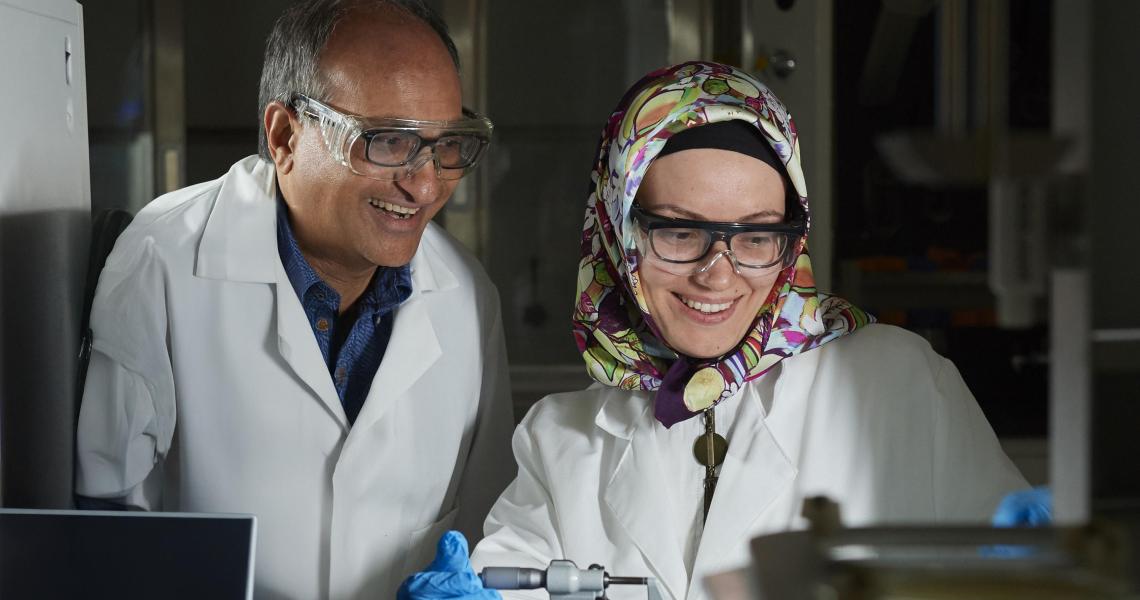
Rajesh Davé, a problem-focused inventor whose groundbreaking methods for re-engineering tiny particles have applications in such diverse areas as rocket fuels and explosives, high-value-added chemicals and pharmaceuticals, has been tapped for the Elsevier Particle Technology Forum Lifetime Achievement Award from the American Institute of Chemical Engineers (AIChE).
Davé, a distinguished professor of chemical and materials engineering at NJIT, draws on physics, chemistry and engineering to understand and manipulate the behavior of particles. For example, by vigorously shaking granular or particulate materials along with nanomaterials, which form a thin coating around them, he is able to optimize their dispersion and delivery, among other processing improvements.
“What I find most interesting about these materials is that they defy easy categorization as solids, liquids or gases. For example, individual particles are solid, but collectively they don’t behave as solids and the established equations governing these states of matter don’t apply,” he said.
Colleagues in the field credit him with developing new methods to synthesize, engineer and mix nano-sized and low micron-sized particles. By imparting them with unique properties resulting from the combination of different size scales, he aims to improve the efficiency and effectiveness of various industrial products and processes, while also reducing consumption of resources and toxic chemicals, such as solvents.
The promise of nanoparticles, Davé notes, is their potential to deliver key compounds in medications, for example, more effectively to “the right place at the right time.” The challenge is to prevent them from forming “large fluffy clusters the size of mustard seeds, which hamper even distribution and also don’t fluidize properly.” He figured out how to engineer these tiny bits, a fraction of the diameter of a human hair, to behave like much larger particles. These improvements apply to medications, fertilizers, high value-added chemicals, paints and sunscreens, as well as fuels and explosives.
He later came up with ways to coat his nano and micro sized particles with thin layers of polymers that can mask the taste of unpleasant drugs and protect materials exposed to the elements from humidity and rusting.
Davé has led or co-led several multi-institution, state and federally funded centers that produced advances in the field, including the New Jersey Center for Engineered Particulates, from 2001-2005, where he partnered with colleagues at Princeton, Rutgers and NJIT to develop new engineered particles and coatings that improve their performance. He was a site leader for the Rutgers-based Engineering Research Center for Structured Organic Particulate Systems, from 2006 to 2019, which received about $35 million in backing from the National Science Foundation and had more than 30 members from industry.
In recent years, he has focused on re-engineering drug particles to enhance the effectiveness of medications in a variety of ways: by increasing the absorption rates of drugs with poor water solubility, delaying the release of medications that degrade in the acidic environment of the stomach and masking the bitter tastes of drugs to make them more palatable for children as well as for adult patients who have difficulty swallowing.
“Drugmakers face a number of fundamental problems,” Davé noted. “Most drug molecules in the pipeline – about 80% – are poorly soluble, for example, making it difficult for the body to incorporate and distribute them effectively. The experimentation needed to bring them to market is lengthy and expensive. Quality, affordability and accessibility remain challenges.”
More than a dozen pharmaceutical companies and equipment manufacturers recently turned to Davé and Calvin Sun, a collaborator at the University of Minnesota who specializes in particle and crystal engineering, to help them tackle shared hurdles in research and development. These include acquiring a better understanding of various powder properties and the ability to predict their behaviors, while exploiting that knowledge to develop ways to design new drugs digitally and simpler methods to manufacture them.
“They said it used to take them 10 to 12 years to develop a new drug at a cost of over a $1 billion, but that they no longer have the luxury of that amount of time or expense,” said Davé. “Our goal is to help them come up with good formulations in a quarter of that time and a tenth of the material cost.”
Different categories of drugs present distinct challenges. For example, one class of analgesics is poorly water soluble and therefore requires additives to increase absorption. On the other hand, a common diabetes drug is too soluble, thus needing additives that will slow the process down so the active ingredients do not wash out of the body before they take effect. High potency drugs, such as contraceptives, come in such tiny amounts that pills with precise amounts of the drug are difficult to manufacture. One of the goals of CIMSEPP is to come up with more efficient formulations that require less filler material, yet achieve high quality and efficacy.
Their Center for Integrated Material Science and Engineering for Pharmaceutical Products (CIMSEPP), a National Science Foundation-designated and funded Industry-University Cooperative Research Center, investigates drug particles at the molecular and particulate scale to see how they behave when blended with other powders and in the various steps of manufacturing, among other settings. The companies directly fund their research and provide mentorship to each of the projects they collectively choose. They share all of the intellectual property developed.
Davé, a fellow of AIChE and the National Academy of Inventors and a former chair of the Particle Technology Forum, will receive his award in November at AIChE’s annual meeting in Boston.
“Being selected for this award means a lot to me since I have been part of this community in various capacities for almost 25 years and have closely known and admired many giants in the field who have previously received this award,” he said. “It is a strong endorsement of the hard work of many students and postdocs who I am fortunate to have worked with.”