NJIT Student Turns Stone into Art, Wins 2025 Business Model Competition
Yusuf Karyagdi is building a business to upcycle leftover material from his father’s stone fabrication company into high-end artwork — and in turn taking first place, plus a $3,000 check, in the student category at NJIT’s 2025 New Business Model Competition.
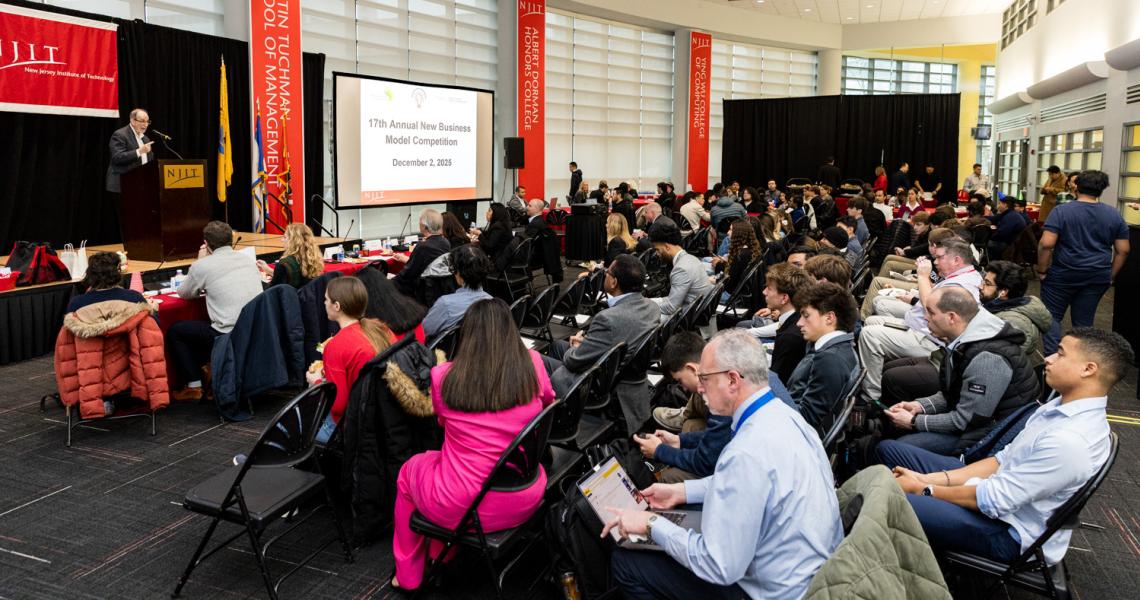
About 100 people entered the competition, with the final eight in the student and community categories giving live presentations.
“We want to open the door to as many people as possible, and one of the ways to do that is to have a very simple business model that everyone can track on and we can compare apples to apples,” explained Michael Ehrlich, associate professor of finance in NJIT’s Martin Tuchman School of Management.
“We don't give a prize here to the company that makes the most money. We don't give a prize here to the company that's farthest along. We give a prize to the company that has the best ideas and tells the best story. Because the key thing for every entrepreneur, you don't have a track record, but the way you gather the resources you need is you tell a really good story,” Ehrlich continued.
He said startups need to answer four questions to succeed: what problem do they solve and for whom; how do they solve it; how will their solution make money or create societal value; and have they identified the competition and stated how they’ll be better?
Karyagdi is a junior and construction management major who said he’d like to continue the business after graduating from college.
“You’d call it scraps, from countertops, backsplashes, anything like that, like pool copings. We actually utilize it to make small pieces, meaning small décor pieces and stuff like that. We just sell it online, sell it to wedding venues.”
“It was my idea at first. So I was working next to the mosaic machine, and we had a lot of tiles coming out with, I'd say 3x3 [inch] scrap. It was around .25-inch height, and I looked at — this could be a coaster. And they were just throwing it out — the workers, they weren't even looking at it.”
Karyagi went home, ran numbers and realized there’s much more he could develop beside drink coasters. He also discovered Etsy stores. He began making wedding items such as card holders and setup cubes.
Now, “It’s a high-margin market. I would definitely recommend looking into it. But you need some expertise for sure because of the stone behavior, tool behavior … You have to understand the market, really understand the tools that you're going to be using and understand the stone.”
He’s using skills learned at NJIT, such as computer-aided drafting software. An artist working solo might not need that technology, but Karyagdi sees a future where employees can manufacture his designs or become inspired to make their own. In the meantime, he intends to take an entrepreneurship course before he graduates.
NJIT has plenty to offer. The university is ranked highly for entrepreneurship, and the Center for Student Entrepreneurship formed a year ago, connecting undergraduates to numerous resources such as government- and alumni-led funding sources.
The event also featured an Entrepreneurial Ecosystem Showcase, where attendees could meet representatives from CSE and MTSM, along with the Center for Translational Research, student-led Entrepreneur's Society, New Jersey Innovation Institute, New Jersey Small Business Development Center, and National Science Foundation I-Corps Northeast Regional Hub.
Additional winners at the competition’s student category were LimbVR, by Natalie Kiwanian; Stacks, from Gabriele Muratori; and SmartComfort, through Mohammed Saleh. Veronica Nunez’s Cafecito Con Fashion won the community category. Other winners were MGL Consulting Group, Mardochee Louis; FreshSpan, Johanna Torres; and Chorah Labs, Jason Chou.
All winners are invited to NJIT's entrepreneurship training this summer, called the Lean Startup Accelerator.