150+ Honors Scholars Showcase Findings at Interdisciplinary Research Forum
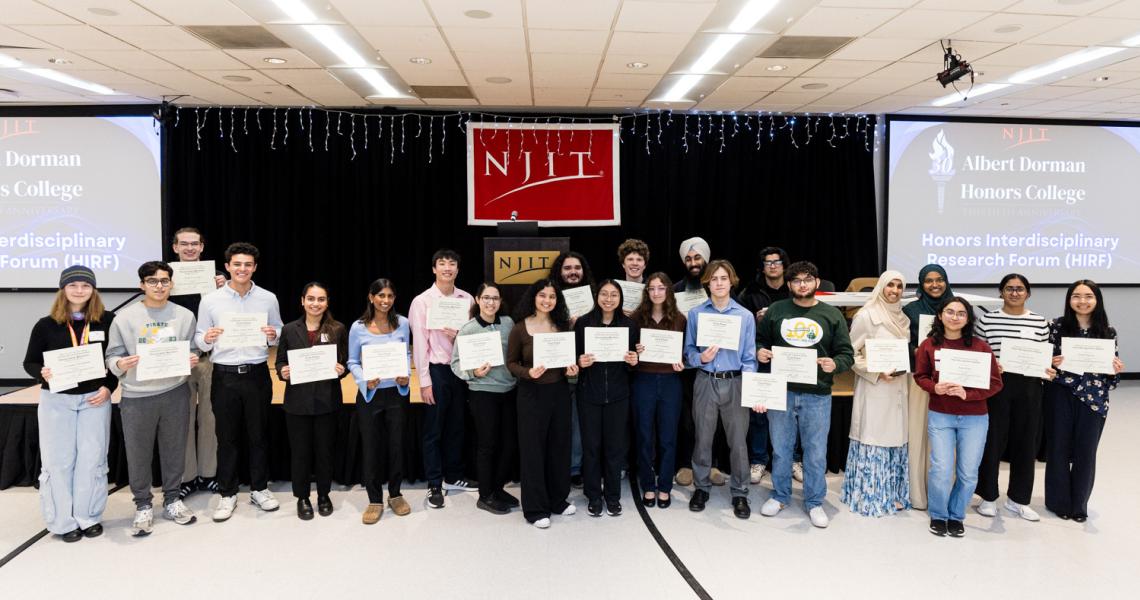
Students from Albert Dorman Honors College’s courses – Introduction to Research Writing, Introduction to Research Methods, Introduction to Entrepreneurship, Science, Technology and Urban Transformation and Introduction to Sustainability Studies – presented their semester's research during the Honors Interdisciplinary Research Forum, with topics ranging from increasing civic engagement in Newark to a comparative analysis of the role of governmental incentives on accelerated electric vehicle adoption.
These honors courses provide an overview of applying the scientific method to real-life research, including ethical concerns, qualitative and quantitative methods, and how to critically evaluate published research findings. Students work with faculty mentors on research projects, while writing proposals for the support of future research.
Forty-five faculty members played the role of judges, and after calculating their grades, announced the winners.
New for this year, the forum included Science Park High School students who presented their research posters on the effects of litter and street pollution in Newark and offered mitigation solutions. The high school students worked alongside NJIT Newark Mayor’s Scholars and Bloom Scholars to produce their research.
“The Honors College is proud to organize perhaps the largest undergraduate research enterprise at the university, and certainly the largest for an Honors College or program in the state of New Jersey,” said Louis I. Hamilton, dean of ADHC. “We're very proud of the work that you're all doing, and that the college is doing in partnership with the university.”
Provost John Pelesko added: “This forum continues to grow each year, it's bigger and better, and this offers our Dorman Scholars a platform to share their interdisciplinary research that they've been working on all semester, that's the heart of what an honors education is all about, turning big ideas into bigger impact.”
Civil engineering student, Ariana Martinez, won first place in the Introduction to Sustainability Studies group. Her project, “Would adopting 15-minute city designs worsen existing inequalities in cities?” looked into ways of how 15-minute cities can be implemented without increasing inequalities and making sure that accessibility to resources is at the core of them.
The concept of 15-minute cities revolves around the idea that any residents in the city have access to services like jobs, education, health care and entertainment, all within a 15-minute walk or bike ride.
“It was interesting to see cities across the world and how they're dealing with increasing accessibility, but also balancing, not worsening, other inequalities,” she said. “Something that stood out to me in the U.S. was that Boston created a fair, free bus line that connects the historically minority and lower income community to the downtown area that has more job opportunities and more services. I think that's really something that's not seen a lot in the U.S., like fare-free public transit, and could be a big help in not alienating people from resources.”
Second-year chemical engineering student, Emely Dennisse Urena, won first place in the Introduction to Research Methods group. Her project, “Investigating Minimum Sand-Bed Depth Required for an Efficient and Short Water Filter,” allowed her to wire one of the mechanisms, turbidity meter, which reads the clarity of the water.
“Overall, it was a fun project to work on, and speaking about it raised my confidence in speaking,” she added. “Usually I don't speak often, so getting to speak aloud, especially in a huge group of people, where you feel like you're being seen, but also there's a lot of other noise around you, raises up your confidence.”
Winners
Introduction to Research Writing
Honorable Mentions
- Rohit Karnik, “Newark’s Lead Service Line Replacement Program as a National Model”
- Jared B. Van Horn, “The Effects of Repair Hegemonization on Consumer Rights and the Environment”
- Elizabeth Soldatenkov, “Quantifying the Mind: Correlating Van Gogh's Mental Health and Color Use”
- Curtis Brian Wang, “Addictiveness of Short-Form Content and Resulting Effects”
First Place
- Shreya Jayanti Dutt, “The Influence of Instructor Accent on Student Perception and Learning Outcomes in Higher Education”
- Dylan Haroon Malik, “Cognitive Bias in DNA Analysis and Forensic Pathology and its Snowballing Effect on Justice”
Introduction to Research Methods
Honorable Mention
- Nancy Natividad Cruz, “Evaluating XR Simulation Effectiveness in Emergency Medical Services Education”
First Place
- Dhyani Soni, “Underwater Image Filtering and Motion Analysis Pipeline for Quantitative Assessment of Motor Function in Aquatic Therapy”
- Emely Dennisse Urena, “Investigating Minimum Sand-Bed Depth Required for an Efficient and Short Water Filter”
Science, Technology & Urban Transformation
First Place
- Sergio Lorenzo Cubas-Roman and Graham Evan Beyer, “Roots and Tiles: Research and Planning for an Urban Garden Mosaic Installation”
Introduction to Entrepreneurship
First Place
- Franco Giovannetti, Remy Fortsch, Suyash Adhikari and Saad Hassan, “Monami: Language learners love Monami because they can practice real conversations without fear of embarrassment at any time and any level”
Introduction to Sustainability Studies
First Place
- Ariana Martinez, “Would adopting 15-minute city designs worsen existing inequalities in cities?”
2025 Honors Summer Research Institute (HSRI)
First Place
- Afsheen Khan, “Project FloodLens - Holographic Flood Simulation for Disaster Risk Assessment”
- Ishaakannan Rajeshkannan, “Optimizing Xenon Microbubble Therapy for Neuroprotection in a Rat Model of Traumatic Brain Injury”
- Kabir Singh, “Development of a novel male contraceptive using lariat peptides to inhibit sperm function”
Peer Recognition Award
- Shaimaa Al-Zaman, Anne Argonza, Kanika Kanika and Azka Faisal, “Hobbybear: Busy people with hobbies love the Hobbybear because it reminds them to take a mental health hobby break”